 Adrit Suite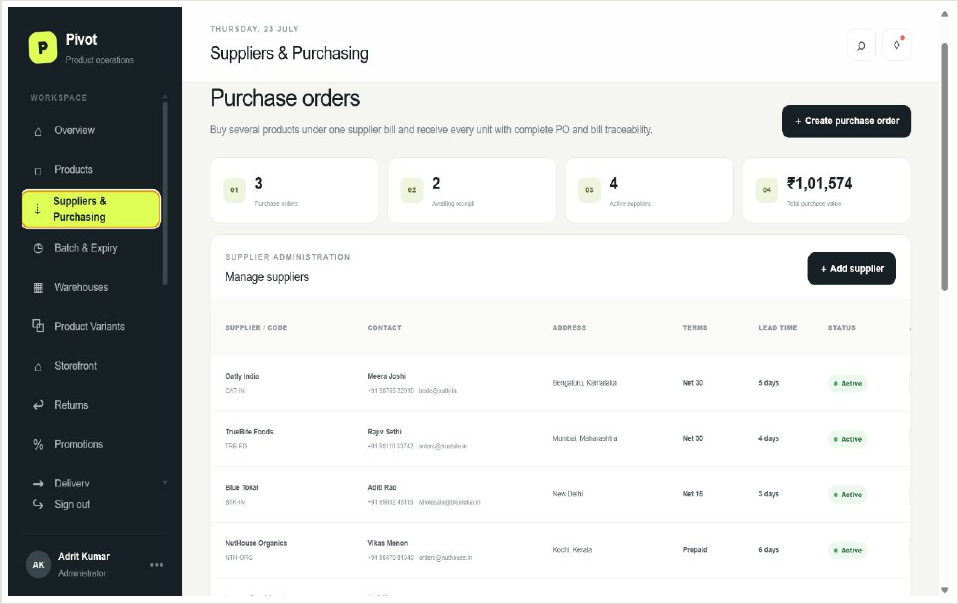
Begin with an accurate recipe cost
Every menu item needs a standard recipe with ingredient quantities, current purchase prices, expected yield and portion size. Without this foundation, managers cannot tell whether a selling price protects the intended margin.
Update recipe costs whenever an important ingredient price changes. Compare the calculated cost with the selling price and contribution margin before deciding whether to adjust price, portion or recipe.
Connect purchasing with actual demand
Buying too much ties up cash and increases spoilage. Buying too little creates emergency purchases, inconsistent pricing and unavailable menu items. Purchase plans should use current stock, open orders, expected sales and realistic supplier lead times.
- Use approved suppliers and agreed prices
- Set reorder levels for essential ingredients
- Compare ordered, received and invoiced quantities
- Record substitutions and price differences
Record stock movement consistently
Inventory accuracy depends on recording every important movement: receiving, production use, transfers, returns, spoilage and adjustments. Regular cycle counts are more useful than waiting for a large month-end count to reveal accumulated errors.
Make waste visible
Waste should be recorded with a reason, quantity, value, location and responsible shift. Useful categories include preparation waste, spoilage, overproduction, returned food and damaged stock. A short daily review can reveal repeat problems while they are still correctable.
Protect portion consistency
Even a profitable recipe can lose margin when portions vary. Give kitchen teams clear specifications, suitable measuring tools and practical training. Review high-cost and high-volume dishes first because small differences there create the largest financial impact.
Use a small set of daily and weekly reports
Managers need timely information they can act on. A focused dashboard should show sales, food-cost percentage, gross profit, purchasing variance, stock exceptions and waste trends by outlet or category.
- Review sales and high-value exceptions daily.
- Check receiving, transfers and waste before closing each shift.
- Compare actual and theoretical usage weekly.
- Investigate the largest variances and assign corrective actions.
- Review menu pricing and supplier performance regularly.
Build one connected operating process
Spreadsheets can calculate costs, but disconnected files make it difficult to keep recipes, purchase prices, inventory and sales aligned. A connected system creates one traceable view from ingredient purchase to menu-item margin. Explore the Adrit Food operations software overview for recipe, inventory, purchasing, billing and reporting capabilities.