 Adrit Suite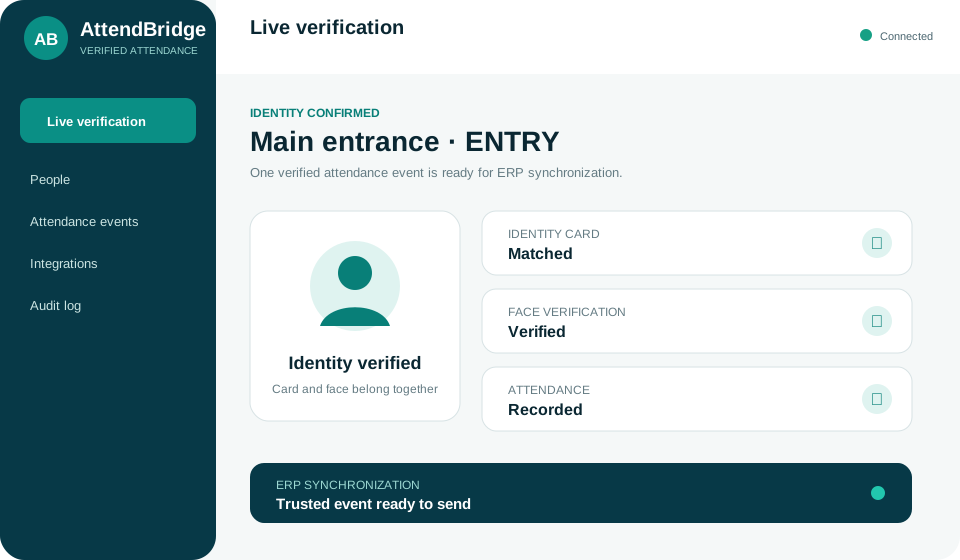
Why attendance integration matters
Many organizations capture attendance in one tool and calculate payroll in another. The gap between them is often filled with spreadsheets, manual adjustments and last-minute messages. That creates opportunities for duplicate records, missed punches, incorrect overtime and payroll delays.
An attendance management software integration should create a controlled path from a real-world event to an approved payroll record. The goal is not simply faster data transfer. It is dependable information with clear ownership at every stage.
The complete attendance-to-payroll workflow
1. Employee enrollment
Enrollment connects an employee or contractor to an authorized identity record. The organization should define who can enroll users, what evidence is required, how changes are approved and how records are removed when access ends.
2. Identity and event verification
At entry or exit, the system verifies the presented identity and records the event with time, location, device and verification outcome. A failed or uncertain match should create an exception rather than silently becoming a valid punch.
3. Attendance rule processing
Raw events must be interpreted using schedules, shifts, grace periods, breaks, holidays and location rules. This is where an early entry becomes a standard shift start, a missing exit becomes an exception and approved overtime becomes a payroll input.
4. Supervisor review
Managers need a focused queue for missing punches, late arrivals, location mismatches and manual corrections. Every adjustment should identify who made it, when it changed and why it was approved.
5. Payroll or ERP synchronization
Only validated information should move downstream. Depending on the target system, integration may send detailed attendance events, approved hours, leave information or a payroll-period summary.
Three common integration patterns
- Real-time API: suitable when the payroll, HR or ERP platform provides stable endpoints and timely synchronization is important.
- Scheduled file exchange: practical for systems that accept structured CSV or similar imports at defined intervals.
- Integration middleware: useful when data needs transformation, retry handling, monitoring or connections to several systems.
The right pattern depends on the target system, transaction volume, timing requirements and failure-handling needs. A good design also defines idempotency so the same event cannot be imported twice.
Controls that protect payroll accuracy
A successful payroll attendance integration should include more than a data connector. Build operational controls around it:
- Use unique employee and attendance-event identifiers.
- Reject incomplete or structurally invalid records.
- Keep source events separate from approved adjustments.
- Record synchronization status, retries and final outcomes.
- Reconcile totals before closing each payroll period.
- Provide a controlled way to correct records without erasing history.
Privacy and security considerations
Identity cards, facial templates and attendance histories can be sensitive. Organizations should determine which privacy, employment and biometric-information laws apply in every operating location. Collect only what is necessary, define retention periods and restrict access according to job responsibilities.
Payroll usually needs an approved attendance result—not the raw image or biometric template used during verification. Keeping sensitive verification data out of downstream systems can reduce exposure and simplify access control.
Metrics to monitor after launch
- Percentage of events verified successfully on the first attempt
- Missing-punch and exception rate by location or shift
- Time required for supervisors to resolve exceptions
- Synchronization failures and duplicate records
- Payroll corrections caused by attendance data
- Employee support requests related to attendance
Implementation checklist
- Map the current enrollment, attendance, approval and payroll process.
- Define a shared employee identifier across systems.
- Document schedules, shifts, exceptions and approval authority.
- Design synchronization, retry and reconciliation behavior.
- Pilot with representative locations and work patterns.
- Train supervisors and communicate the process to employees.
- Review accuracy and privacy controls before wider rollout.
Build a trustworthy connection, not just an attendance feed
The best attendance integration creates confidence for employees, managers, payroll teams and auditors. It captures clear evidence, routes uncertainty to a person and sends only approved information to the systems that need it.
Explore AttendBridge identity-verified attendance software or discuss how it could connect to your current HR, payroll or ERP environment.
Frequently asked questions
Can attendance software integrate with an existing payroll or ERP system?
Yes. A suitable integration can send validated events, approved work hours or payroll-ready summaries through supported APIs, scheduled files or controlled middleware.
Does facial verification eliminate attendance fraud?
No technology removes every risk. Verification should be combined with enrollment controls, exception review, device security, audit logs and clear workforce policies.
Should raw biometric images be sent to payroll?
Normally payroll needs an approved attendance record, not biometric source data. Minimize sensitive-data movement and obtain appropriate privacy and legal guidance.